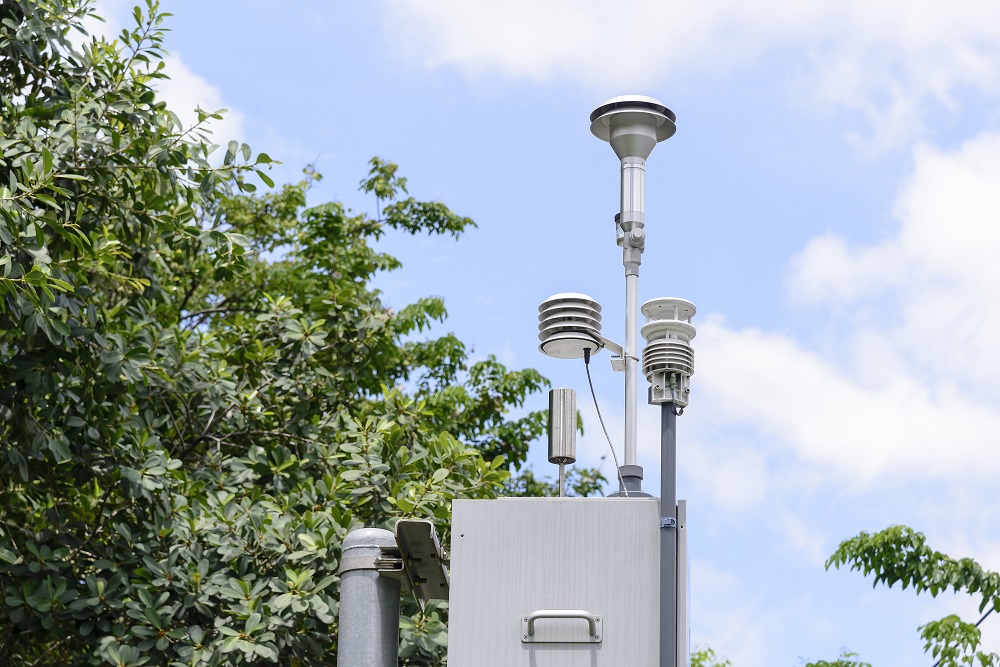
Question: What is air quality monitoring?
Answer: Air quality monitoring is the measurement of pollutant concentrations in ambient air at a specific location over a defined period. Monitoring provides real, site-specific data on pollutants such as nitrogen dioxide (NO2), particulate matter (PM10 and PM2.5), sulphur dioxide, ozone and volatile organic compounds.
Monitoring data is used to establish baseline conditions for planning assessments, verify dispersion modelling, demonstrate compliance with planning conditions or environmental permits, and investigate complaints. It provides planning authorities and regulators with robust evidence of actual conditions rather than relying solely on modelled or published background data.
Question: When is air quality monitoring required for planning?
Answer: Local Planning Authorities may require monitoring where existing data is insufficient to characterise local conditions, particularly for:
- Sites within or adjacent to an Air Quality Management Area (AQMA)
- Residential, school or care home developments close to busy roads
- Developments near industrial sources, energy centres or waste facilities
- Sites where modelled concentrations are close to air quality objectives
- Planning conditions requiring pre-construction or operational monitoring
- Construction sites subject to dust monitoring requirements
Monitoring is often specified by Environmental Health Officers during pre-application discussions or through planning conditions.
Question: What methods are used for air quality monitoring?
Answer: The method depends on the pollutant, the required accuracy and the duration of the survey. Common approaches include:
- Passive diffusion tubes for nitrogen dioxide, typically deployed for a minimum of three to six months
- Continuous automatic analysers for NO2, PM10 and PM2.5
- Optical particle counters for construction dust monitoring
- Dust deposition gauges and directional dust monitors
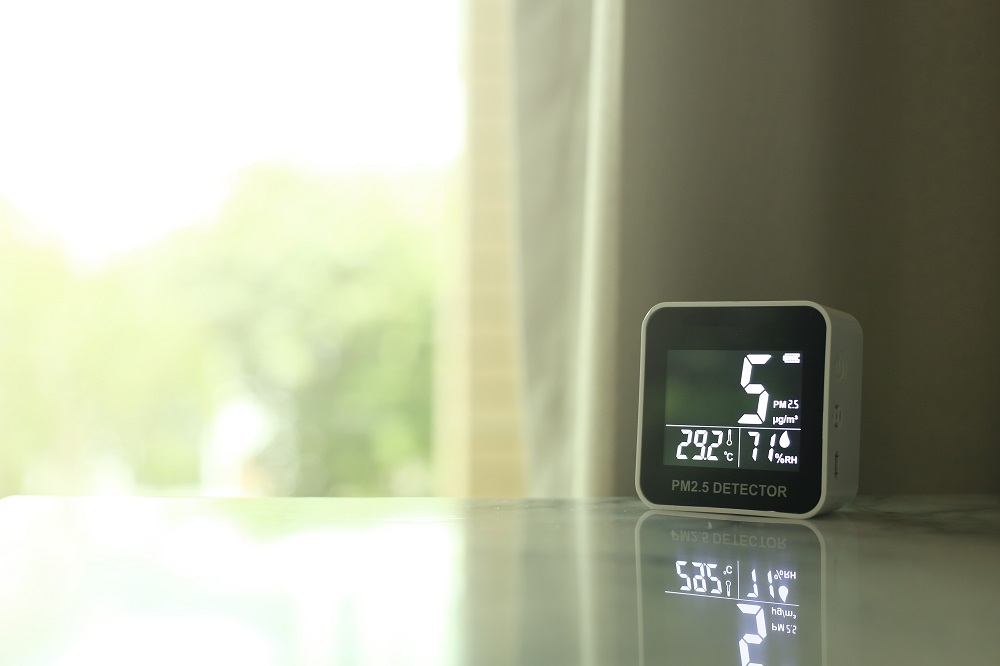
- Portable indoor air quality monitors for CO2, VOCs and particulates
Diffusion tubes are analysed by UKAS-accredited laboratories and results are bias-adjusted in line with DEFRA LAQM.TG(22) guidance.
Question: How long does an air quality monitoring survey take?
Answer: Survey duration depends on its purpose. Diffusion tube surveys are usually run for at least three months, and ideally six to twelve months, to allow results to be adjusted to an annual mean. Construction dust monitoring runs for the duration of the relevant works. Short-term indicative surveys can be completed within a few weeks where a rapid screening exercise is required.
Because planning programmes can be tight, it is advisable to commission monitoring as early as possible so that data is available in time for the Air Quality Assessment.
Question: What is the difference between monitoring and modelling?
Answer: Monitoring measures actual pollutant concentrations at the monitoring location during the survey period. Modelling predicts concentrations using emissions data, meteorology and dispersion software such as ADMS, and can assess future scenarios that cannot be measured, such as the impact of a proposed development.
The two approaches are complementary. Monitoring is used to establish baseline conditions and to verify and adjust the model so that predictions are reliable. Planning authorities often expect both where a site is in a sensitive location.
Question: What is construction dust monitoring?
Answer: Construction dust monitoring measures particulate matter and dust deposition around the boundary of a demolition or construction site to protect nearby residents, businesses and sensitive receptors. It is frequently required by planning conditions or Construction Environmental Management Plans (CEMPs) for medium and high-risk sites identified through an IAQM dust risk assessment.
Real-time monitors can be set with alert thresholds so that site managers are notified immediately if dust levels rise, allowing mitigation such as damping down or suspending activities to be implemented promptly.
Question: How are monitoring results reported?
Answer: Results are presented in a technical report that compares measured concentrations with national air quality objectives and, where relevant, the assumptions used in the Air Quality Assessment. The report explains the methodology, quality assurance, bias adjustment and any limitations of the data.
Monitoring reports are commonly submitted to discharge planning conditions, support planning applications or demonstrate compliance to the Environment Agency.
Question: Why choose Syntegra Group for air quality monitoring?
Answer: Syntegra Group designs and delivers air quality monitoring programmes across the UK, using UKAS-accredited laboratory analysis and recognised DEFRA and IAQM methodologies. We select monitoring locations and methods that will satisfy Local Planning Authorities and Environmental Health Officers, and we integrate the results directly into our Air Quality Assessments and dispersion modelling.
Our team provides clear, well-presented reports that can be used to discharge planning conditions and support planning applications, helping to minimise delay and provide certainty for developers and design teams.