Life-time cost and carbon savings can be easily made by making small simple specification changes to a base design of a building. The materials and components chosen for a building will have an impact on a building’s performance, both financially and economically throughout its lifetime.
Financial and environmental costs should be coupled together whenever thinking about construction or refurbishment. The reason for this is that every time something has to be altered or replaced both a financial and environmental cost follows. Adding these costs onto increasing governmental pressures, growing energy prices and more sophisticated public ethics are leading to a requirement of demonstrating intelligent, green sustainable design choices. It is becoming increasingly more important for construction professionals to be able to present their client with alternatives, so that cost and carbon savings can be applied.
To understand the cost and carbon savings that can be achieved by using alternative design ideas the life-time performance of a typical railway over bridge (single 11m span over-bridge) has been studied. Option 1- Pre- stressed Concrete Beam and Option 2- Modular Steel and Concrete Deck.
By changing to an alternative design a total life cost and carbon saving of 6.5% of total cost and 7% (Mott MacDonald, 2014) of total carbon can be made from the original design. This is an example of how a simple change during the design stage of a project can positively impact the life-time performance of the building, and how the option with the lowest capital cost is not the asset with the lowest life cost.
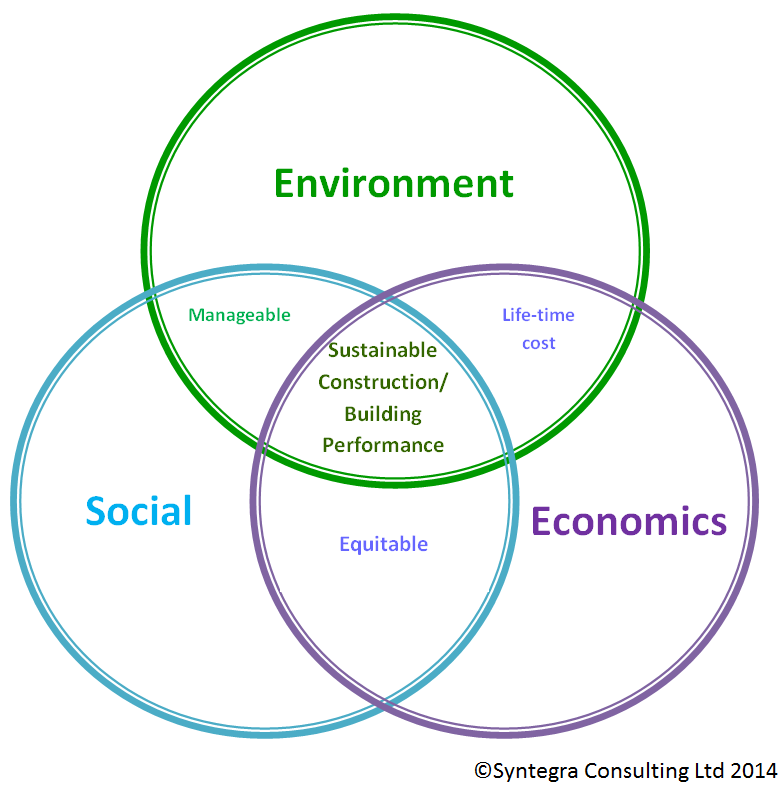
Clients and designers want to be able to pick the best value specification choices for building plans; this then results in increasing requests for whole life costs or life cycle costs to help with the decision. There is a growing need for future carbon performance of a construction design to be drawn up, as well as future financial performances of the building.
Sustainability is now established as an important factor in the industry and is set to remain that way. Legislation along with reduction targets and pledges are in place, it is now up to the construction industry to make the relevant changes to protect the environment.
Syntegra Consulting is a leading energy consulting company in the UK – for further information regarding zero carbon buildings, energy efficiency and renewable energy investments, please telephone +44(0)1184028520 or e-mail: mail@syntegra-epc.co.uk
Mott MacDonald. (2014). Cost and Carbon Efficient Construction. Economic Bulletin, pg6-7.