UK Prime Minister Boris Johnson has unveiled his Government’s Net Zero Strategy – Building Back Greener – claiming the country is leading the Green Industrial Revolution which will provide a significant competitive edge on the global platform.
Last year, the Prime Minister set out his 10 point plan for a green industrial revolution, laying the foundations for a green economic recovery from the impact of COVID-19 with the UK at the forefront of the growing global green economy.
This new strategy builds on that approach to keep the UK on track for carbon budgets, its 2030 Nationally Determined Contribution, and net zero by 2050. It includes:
- decarbonisation pathways to net zero by 2050 scenarios
- policies and proposals to reduce emissions for each sector
- action to support the transition
Launching the strategy, the PM said hundreds of thousands of new ‘high skilled, high wage green jobs’ would be created.
In the report foreword, he wrote: ‘We will meet the global climate emergency but not with panicked, short-term or self-destructive measures as some have urged. Instead we will unleash the unique creative power of capitalism to drive the innovation that will bring down the costs of going green, so we make net zero a net win for people, for industry, for the UK and for the planet.’
He said this would be done by making carbonfree alternatives cheaper and ensuring green, clean electricity prices would be ‘competitive with carbon-laden gas’, and with most of the UK’s electricity coming from the wind farms of the North Sea or state-of-the-art British nuclear reactors ‘we will reduce our vulnerability to sudden price rises caused by fluctuating international fossil fuel markets’.
Emphasising the need for net zero policies, Mr Johnson wrote: ‘The good news is that there is, still, a path to avoid catastrophic climate change. The science could not be clearer: by the middle of this century the world has to reduce emissions to as close to zero as possible, with the small amount of remaining emissions absorbed through natural carbon sinks like forests, and new technologies like carbon capture. If we can achieve this, global emissions of greenhouse gases will be ‘net zero’’.
He pledged to work with businesses to continue delivering ‘deep cost reductions in low carbon tech through support for the latest state of the art kit to bring down costs for consumers and deliver benefits for businesses’.
His strategy confirmed an end to fossil-fuel powered electricity production by 2035 and the hosting of 40GW of offshore wind production by 2030. A total of £380m in funding for the required technology has been promised.
According to the Government, hydrogen can support up to 10,000 jobs by 2030 in fuel supply alone and the Strategy commits to mobilising between £20-30bn in investment as part of an existing plan to deliver 5GW of hydrogen production capacity by 2030. This, the Strategy claims, will halve emissions from oil and gas.
The Government has already set up the Industrial Decarbonisation and Hydrogen Revenue Support (IDHRS) scheme to fun new hydrogen and carbon capture clusters. The Strategy notes that up to £140m will be provided here, including up to £100m to award contracts of up to 250MW of electrolytic hydrogen production capacity in 2023 with further allocation in 2024.
Government will aim to support up to 100,000 green jobs across the built environment by the mid-2020s, rising to 175,000 by 2030. Investment here will reach around £200bn.
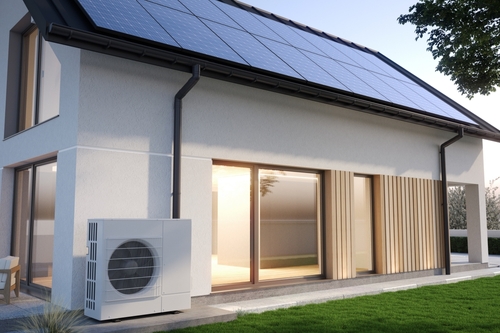
As outlined in the Heat and Buildings Strategy, the Government will aim to ensure that all new heating appliances in homes and workplaces from 2035 are low carbon. This will be facilitated through a £450m boiler upgrade scheme for homes as part of a broader £3.9bn funding package.
The Strategy also includes previously confirmed funding for the Social Housing Decarbonisation Scheme and Home Upgrade Grants (reaching £1.75bn) and £1.425bn for Public Sector Decarbonisation, with the aim of reducing emissions from public sector buildings by 75% by 2037.
Under the strategy, £620m will be made for zero-emission vehicles and EV infrastructure. A further £350m will be invested on top of the existing £1bn Automotive Transformation Fund (ATF) to support the electrification of UK vehicles and their supply chains.
The Net-Zero Strategy states the Government will boost the current £640m Nature for Climate Fund with a further £124m for peat restoration, woodland creation and management.
Another commitment will include restoring approximately 280,000 hectares of peat in England by 2050 and trebling woodland creation rates in England meaning a target of planting rates of 30,000 hectares per year by the end of the Parliament.