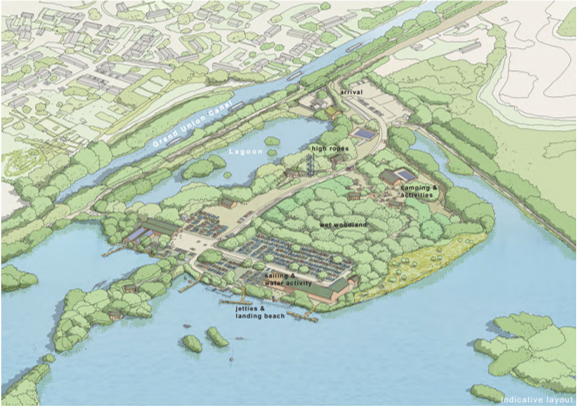
Development plans are set to include detailed calculations on the biodiversity net gain of their projects in a bid to reverse losses of natural habitats from previous construction schemes.
Industry associations have teamed up to produce guidance on the scheme first launched by DEFRA to improve provision of natural habitats for species potentially displaced by building works.
The Chartered Institute of Ecology and Environmental Management (CIEEM), Construction Industry Research and Information Association (CIRIA) and Institute of Environmental Management and Assessment (IEMA) have stepped in to promote the net gain approach and councils are expected to demand plans include calculations according to an agreed matrix showing a positive or negative indicator score against their proposals when they submit their applications.
Syntegra’s Director of Ecology Services, Trish Holden, said: ‘It’s likely these calculations on roll out will be aimed at the medium to large development schemes – some councils have already started asking for applications to include the audits which factors in newly created habitats and the overall risk of implementation. ’
CIEEM President, Max Wade, said: “If biodiversity net gain is to be effective in reversing the catastrophic losses of biodiversity, it is essential that it is designed and delivered to a high standard. This new guidance will help all those keen to learn how to use this new approach and apply it to a range of different types of development.”
To download the new guidance documents please visit: www.cieem.net/biodiversity-net-gain
* In 2015, world leaders agreed to 17 goals for a better world by 2030. https://www.globalgoals.org/ These goals have the power to end poverty, fight inequality and stop climate change. Guided by the goals, it is now up to all of us, governments, businesses, civil society and the general public to work together to build a better future for everyone. Syntegra’s work is underpinned by many of the goals.
Goal 15 states: A flourishing life on land is the foundation for our life on this planet. We are all part of the planet’s ecosystem and we have caused severe damage to it through deforestation, loss of natural habitats and land degradation. Promoting a sustainable use of our ecosystems and preserving biodiversity is not a cause. It is the key to our own survival.
15.5: PROTECT BIODIVERSITY AND NATURAL HABITATS
Take urgent and significant action to reduce the degradation of natural habitats, halt the loss of biodiversity and, by 2020, protect and prevent the extinction of threatened species.